
CHRONOLOGY
Incarnation
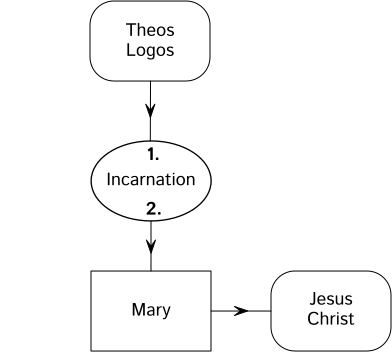
The incarnation was a miraculous conception consisting of two parts:
- Descent: Theos Logos came down from Theos.
- Implantation: Theos Logos became flesh in Mary.
Theos Logos is Jesus Christ and Mary is his mother.
It is in no way certain that the year immediately before the year we call AD 1 actually was the year in which the miraculous conception took place.
The year immediately before the year we call AD 1 is just the year Dionysius Exiguus has established as the year in which the miraculous conception took place.
The miraculous conception is said to have occurred on 25 March.
Anno Domini
Alden Mosshammer writes:
"If Dionysius Exiguus meant to number the years from the birth of Christ, rather than the conception, then it is more likely that he considered that event to have occurred on 25 December, seven days before the start of the year that we call AD 1. The consensus of most modern scholars favours that interpretation." (Text)
The time Before Christ (BC) lasts until the beginning of our common era Anno Domini (AD). It is said that Christ was born seven days before the beginning of our common era AD and he was circumcised on the eighth day. It is said that Christ was born in the time BC and he was circumcised on New Year’s Day in the year we call AD 1.
Dies Domini
A year 0 does not exist in Anno Domini, but a year 0 does exist in the Gregorian proleptic calendar ISO 8601.
In the Gregorian proleptic calendar ISO 8601, the year 0 [0000] is the year immediately before the year 1 [0001].
We can use the Gregorian proleptic calendar ISO 8601 instead of Anno Domini. We can count days and years before and after the beginning of the year 0 [0000].
The beginning of the year 0 [0000] is the chronological epoch Dies Domini 0.0.
Days

According to the Bible, Jesus Christ was crucified on the day before the Sabbath and he rose from the dead on the third day.
These three days, from the beginning of the day he was crucified to the end of the day he rose from the dead, are called Triduum Paschale.
The events during Triduum Paschale took place on three separate days in the weekday cycle.

The weekday cycle begins with either day 1 or day 0.
Ancient time

In ancient time, the cycle of days begins with day 1. The cycle of days is infinite after the beginning of day 1.
Modern time

In modern time, the cycle of days begins with day 0. The cycle of days is infinite both before and after the beginning of day 0.
Hours
An hour is a subdivision of the day. The length of an hour is either variable or fixed.
Ancient time

In ancient time, the day has 12 daytime hours from sunrise to sunset, and 12 nighttime hours from sunset to sunrise.
The first hour after sunrise is the first daytime hour, and the first hour after sunset is the first nighttime hour. It is midday at the sixth daytime hour, and midnight at the sixth nighttime hour.

Because of the changing seasons, the length of an hour is variable.
Modern time

In modern time, the day has 24 clock hours from midnight to midnight.
It is midday at 12:00 and midnight at 00:00. The length of a clock hour is fixed at 3600 SI seconds.
Sunday

"Throughout history there have been different choices for beginning the day. The ancient Egyptians began the day at dawn, but the Babylonians and Jews chose sunset. The ancient Romans switched to midnight after first using sunrise to mark the day’s beginning. Sunrise was the most common choice in Western Europe before the general use of clock time." (Text)
In the gospels, the events during Triduum Paschale are described as a sequence of events. The chronology of the sequence of events during Triduum Paschale depends on whether the days are reckoned from sunrise to sunrise, sunset to sunset, or midnight to midnight.
Before we continue, the following warning should be noted. Bede writes:
"All the mysteries of the seventeenth day of the Moon, wherein on a Sunday the first deeds of His most holy Resurrection took place, are set forth in unambiguous sequence. Only let us be extremely careful lest, by affirming as do some that this was accomplished on the sixteenth Moon, we incur not only an inevitable loss to our computation, but a very great danger to the catholic faith." (Text)/(Latin)
Sunrise

The figure shows the chronology of the sequence of events during Triduum Paschale, if the days are reckoned from sunrise to sunrise. To the left are the changing times, and at the top are the changing days of the week.
Sunset

The figure shows the chronology of the sequence of events during Triduum Paschale, if the days are reckoned from sunset to sunset. To the left are the changing times, and at the top are the changing days of the lunar month. The days from sunrise to sunrise are written in parentheses.
Between the days from sunrise to sunrise and the days from sunset to sunset, the following differences are obvious:
His last supper and his crucifixion took place on two different days (Thursday and Friday), if the days are reckoned from sunrise to sunrise, but on the same day (14), if the days are reckoned from sunset to sunset.
His resurrection and Jn 20:19-23 took place on the same day (Sunday), if the days are reckoned from sunrise to sunrise, but on two different days (16 and 17), if the days are reckoned from sunset to sunset.
In the Gospel of John, the days are reckoned from midnight to midnight
In the Gospel of John, his last supper was a meal before the feast of Passover (Jn 13:1).
The Gospel of John says:
"Now before the feast of Passover ... And as a dinner was taking place". (Jn 13:1-2)
In the Gospel of John, his last supper was a meal before the feast of Passover, because the days there are reckoned from midnight to midnight.
Jack Finegan writes:
"In the Fourth Gospel, on the other hand, we saw that the day must have been reckoned from the preceding midnight, according to what Pliny tells us was official Roman usage." (Text)
Two passages in the Gospel of John clearly indicate that, in the Gospel of John, the days are reckoned from midnight to midnight:
1
a) On the first day of the week (Sunday), Mary came to the tomb "while it was still dark" (Jn 20:1).
At sunrise, it is not dark.
If the days are reckoned from sunrise to sunrise, it would have been Saturday, not Sunday, when Mary came to the tomb "while it was still dark". Therefore, the days are not reckoned from sunrise to sunrise.
b) Jesus came to the disciples "when it was evening on that day, the first day of the week" (Jn 20:19).
Here, the text explicitly and inextricably connects the evening (ὀψίας/opsias) to the same day Mary came to the tomb. If the days are reckoned from sunset to sunset, the evening would have marked the beginning of a new day (the second day of the week / 17 Nisan). Since the Gospel of John maintains that this evening occurred on that same day, the days are not reckoned from sunset to sunset either.
c) In the Gospel of John, Sunday is reckoned neither from sunrise to sunrise nor from sunset to sunset. This indicates that, in the Gospel of John, the days are reckoned from midnight to midnight.
2
The Bible says:
"From the evening of the fourteenth day of the first month until the evening of the twenty-first day of this month you will eat unleavened bread. For seven days no leaven may be found in your houses." (Ex 12:18-19)
The Bible says seven days without leaven (15, 16, 17, 18, 19, 20, 21), but a lamb was to be killed on the fourteenth day (Ex 12:6), and if the fourteenth day is included in the feast of Passover, there are eight and not seven days from the fourteenth to the twenty-first (14, 15, 16, 17, 18, 19, 20, 21). Therefore, the Gospel of John distinguishes between the day of preparation (14) and the first day without leaven (15).
- Jesus Christ was crucified on the day of preparation (14) (Jn 19:14).
- The first day without leaven (15) was both the Sabbath and a great (μεγάλη/megalē) day (Jn 19:31).
The people removed the leaven on the fourteenth day. The Quartodecimans observed the Passover on the fourteenth day.
Midnight

The figure shows the chronology of the sequence of events during Triduum Paschale, if the days are reckoned from midnight to midnight. To the left are the changing times, and at the top are the changing days of both the week and the lunar month.
If the days are reckoned from midnight to midnight, the feast of Passover began with the day of preparation (14) at midnight between Thursday (13) and Friday (14). His last supper took place in the evening on Thursday (13) and was therefore a meal before the feast of Passover. This also indicates that, in the Gospel of John, the days are reckoned from midnight to midnight.
Alden Mosshammer writes:
"If Pilate had tried and executed Jesus on the fifteenth day of Nisan, he would have been profaning a Jewish holy day of rest. For this and other reasons, many modern scholars prefer the Johannine account." (Text)
Week

The third day of Triduum Paschale marks the last day of a new week.
- The old week is the period of seven days reckoned from sunset Saturday to sunset Saturday.
- The new week is the period of seven days reckoned from midnight Sunday to midnight Sunday.
In the old week, Sunday is the first day (post sabbatum).
In the new week, Sunday is the seventh day (post dominicam).
The Bible says:
"And you shall count for yourselves from the day after the Sabbath, from the day of your bringing the wave offering’s sheaf—there shall be seven full weeks. Until the day after the seventh Sabbath you shall count fifty days". (Lv 23:15-16)
In other words, the Bible says seven full weeks, from the beginning of the day following the Sabbath (1) to the end of the fiftieth day (1-50).
The eighth day counted from Palm Sunday

Palm Sunday marks the first day of a holy week. The last day of the holy week is the eighth day counted from Palm Sunday.
The eighth day counted from Palm Sunday is: (i) the third day of Triduum Paschale, (ii) the last day of the holy week, (iii) the first day of the count to Pentecost.
The count to Pentecost (1–50) is the eighth day plus seven full new weeks (1+(7x7)=50).
Scaliger
Link: Dionysian Paschal table
Joseph Scaliger is famous for his 7980-year cycle. It is the product of the number of years in a 15-year cycle multiplied by the number of years in a 19-year cycle multiplied by the number of years in a 28-year cycle. 15x19x29=7980.
Scaliger writes:
"To avoid any cumulative error due to the long series and interconnection of the epochs, I have devised a period which contains both cycles [19x28=532] and the indictions [15]. I shall call this the Julian Period." (Text)
532x15=7980.
Link: Scaliger’s 7980-year cycle
15-year cycle

In the 15-year cycle, each year has a number from 1 to 15.
In Scaliger’s 7980-year cycle, the number from 1 to 15 equals 3 in the year 1 BC.
19-year cycle

In the 19-year cycle, each year has a number from 1 to 19. After 19 Julian years, the same lunar phases occur on the same dates in the Julian calendar. 19 Julian years contain 235 lunar months.
The number above the number from 1 to 19 is the Dionysian epact. In year 1, the Dionysian epact is 0, which Dionysius writes nulla. In each following year, 11 is added to the epact; whenever the total reaches 30, 30 is subtracted.
The epacts of the 19 years are therefore: 0, 11, 22, 3, 14, 25, 6, 17, 28, 9, 20, 1, 12, 23, 4, 15, 26, 7, 18.
Eleven is added because twelve lunar months are eleven days shorter than a Julian year. The Moon is therefore eleven days older on the same calendar date in the following year.
At the end of the 19-year cycle, the saltus lunae adds one extra lunar day to the epact number, so that 12 rather than 11 is added to the epact. The epact therefore changes from 18 in year 19 to 0 in year 1.
In Scaliger’s 7980-year cycle, the number from 1 to 19 equals 1 in the year 1 BC.
28-year cycle

In the 28-year cycle, each year has a number from 1 to 28.
The letters above the numbers are the dominical letters. The red numbers are leap years (366 days), and the black numbers are ordinary years (365 days). A leap year has a double dominical letter and an ordinary year has a single dominical letter.
The dominical letter shows the date of the first Sunday of the year.
Every day of the year has one of the seven lowercase letters in the repeating sequence: a, b, c, d, e, f, g. In a bissextile year, the letter of the leap day is repeated on the following day; this causes the dominical letter to change to the preceding letter for the remainder of the year. The first day of the year (1 January) always has the lowercase letter a.
The dominical letter A shows that the date of the first Sunday of the year is 1 January. The dominical letter G shows that the date of the first Sunday of the year is 7 January.
The leap day every fourth year is always in February. In an ordinary year, all Sundays have the same letter as the dominical letter, but in a leap year, all Sundays before the leap day have the first of the two letters in the double dominical letter and all Sundays after the leap day have the second of the two letters in the double dominical letter.
In the proleptic Julian calendar, the year 1 BC is a leap year and the first Sunday of that year is 4 January. The year 1 BC therefore had the double dominical letter DC.
Scaliger writes:
"The year in which the birth of Christ is commonly held to have fallen had the double dominical letter DC and was therefore 9 in the Roman solar cycle." (Text)
The 28-year cycle that Scaliger uses is described by Robert of Leicester. He writes:
"It should hence be known that the letter G is not, nor can it be, the dominical letter in March, except in the 6th or 12th or 17th or 23rd year of the solar cycle." (Text)
In Scaliger’s 7980-year cycle, the number from 1 to 28 equals 9 in the year 1 BC.
Epoch
John Herschel writes:
"The first year of the current Julian period, or that of which the number in each of the three subordinate cycles is 1, was the year 4713 BC, and the noon of the 1st of January of that year, is the chronological epoch." (Text)
Combinations

Link: The Julian Period
532

JD
P. Kenneth Seidelmann writes:
"The number assigned to a day in this continuous count is the Julian day number which is defined to be 0 for the day starting at Greenwich mean noon on 1 January 4713 BC, Julian proleptic calendar. The Julian day number therefore denotes the number of days that has elapsed, at Greenwich noon on the day designated, since the preceding epoch. The Julian date (JD) corresponding to any instant is, by a simple extension of this concept, the Julian day number followed by the fraction of the day elapsed since the preceding noon." (Text)
ISO 8601
ISO 8601 is an international standard for representation and interchange of date and time.
- Date is written in the format: yyyy-mm-dd.
- Time is written in the format: hh:mm:ss.
Date and time combined are separated by T: yyyy-mm-ddThh:mm:ss.
ISO 8601:2019 says:
"This document uses the Gregorian calendar for the identification of calendar days (4.2.1). This document allows the identification of calendar years by their year number for years both before and after the introduction of the Gregorian calendar (4.2.1)." (Text)
October 1582

The red line shows the introduction of the Gregorian calendar.
At the introduction of the Gregorian calendar, the Gregorian calendar jumps from the fourth of October in the Julian calendar to the fifteenth of October in the Gregorian calendar.
The Gregorian proleptic calendar ISO 8601 applies the leap year rules of the Gregorian calendar in both the time before and the time after the introduction of the Gregorian calendar.
- In the time after the introduction of the Gregorian calendar, there is no difference between the Gregorian calendar and ISO 8601.
- In the time before the introduction of the Gregorian calendar, there is almost always a difference between the Julian calendar and ISO 8601.
Only from 0200-03-01 to 0300-02-28 (both days included) is there no difference between the Julian calendar and ISO 8601.
ISO 8601:2019 says:
"Each Gregorian calendar year can be identified by a 4-digit ordinal number beginning with ‘0000’ for year zero (4.3.2)." (Text)
Year 0

A year 0 does not exist in Anno Domini, but a year 0 does exist in the Gregorian proleptic calendar ISO 8601.
Dies Domini

Dies Domini is a supplement to the Gregorian proleptic calendar ISO 8601.
As a supplement to ISO 8601, Dies Domini is a continuous count of days and fractions of days before and after the chronological epoch 0.0.
The chronological epoch 0.0 is the ISO date 0000-01-01T00:00:00. In ISO 8601, 0000-01-01T00:00:00 indicates local time, whereas 0000-01-01T00:00:00Z indicates UCT (at the prime meridian).
The epoch day 0 is the same Saturday as 0000-01-01.
Link: Dies Domini
Date

Date and time

New Year

The annual celebration of New Year can be considered an eight-day festivity (NEW YEAR), where both the first day of the festivity (12-25) and the last day of the festivity (01-01) are holidays.
12-25
12-25 is marked as X-day.
X is the first letter of the Greek word ΧΡΙΣΤΟΣ/CHRISTOS.
"And Logos became flesh and took up residence among us, and we saw his glory, glory as of the one and only from the Father, full of grace and truth. John testified about him and cried out, saying, ‘This one was he about whom I said: The one who comes after me is ahead of me, because he existed before me.’ For from his fullness we have all received, and grace after grace. For the law was given through Moses; grace and truth came about through Jesus Christ." (Jn 1:14-17)
01-01
01-01 is marked as 0-day.
01-01 is New Year’s Day and the anniversary of the epoch day 0000-01-01.
01-01 begins at midnight (00:00:00) between 12-31 and 01-01.
A new millennium begins at midnight (00:00:00) between a year ending with 999-12-31 and the following year beginning with 000-01-01.